
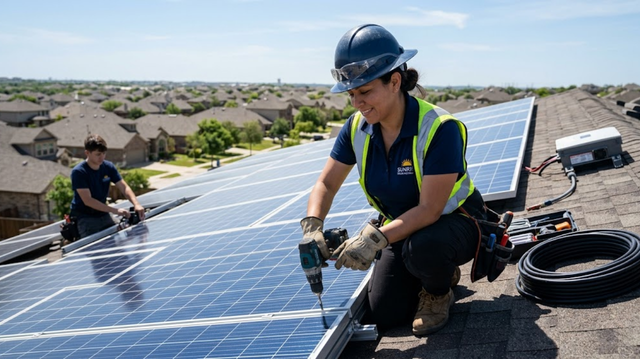
Factors That Influence Your Final Solar Installation Price
Apr/25/2026 909Factors That Influence Your Final Solar Installation Price
If you’ve been tracking solar prices for a few years, you’ve likely noticed a trend that feels a bit like a rollercoaster. In 2026, the "soft costs"—permitting, labor, and customer acquisition—have become just as influential as the "hard costs" of the panels themselves. While the technology has become more efficient, global trade shifts and high demand for local labor have created a new pricing landscape for homeowners.
On average, a residential solar installation in 2026 typically lands between $15,000 and $36,000 before incentives. Based on current data from EnergySage, the national average is approximately $2.50 to $3.50 per watt installed. However, because every roof is a unique engineering project, your neighbor’s $20,000 quote could easily be $30,000 for your home. Understanding the specific variables that shift these numbers is the only way to ensure you are getting a fair market rate for your investment.
1. System Size and Energy Consumption Requirements
The most obvious factor in your solar bill is the total wattage of the system. In 2026, solar is priced on a "per-watt" basis, which allows for an apples-to-apples comparison across different installers.
A home that uses 1,000 kWh per month will require a significantly larger array than a home using 500 kWh. Because there are fixed costs associated with every job—such as permitting and truck rolls—larger systems actually benefit from "economies of scale." As noted by Forbes Advisor, larger 10 kW systems often have a lower price-per-watt than smaller 5 kW systems, even though the total sticker price is higher.
2. Equipment Selection: Efficiency vs. Economy
Not all solar panels are created equal. In 2026, the market is primarily split between high-efficiency N-type cells and standard monocrystalline panels.
- Premium Panels: Brands like Maxeon or certain high-output N-type modules offer efficiencies above 22%. These are ideal for small roofs but carry a 20% to 30% price premium.
- Standard Panels: If you have a massive, south-facing roof, you can save money by choosing standard 400W+ panels. You’ll need more of them, but the lower cost per module reduces the initial price.
Your choice of inverter—string inverters versus microinverters—can also swing your quote by $1,000 to $3,000. Microinverters are more expensive but are often necessary if your roof suffers from partial shading.
3. Roof Complexity and Structural Integrity
Your roof is the foundation of your solar power plant, and its condition dictates the difficulty of the labor. A simple, south-facing asphalt shingle roof results in the lowest labor costs.
However, if your roof is steep, has multiple tiers, or is made of premium materials like clay tile or slate, expect labor costs to increase by $2,000 to $5,000. Installers must use specialized mounting brackets and take more time to ensure the roof’s water-tightness. If your roof is older than 10–15 years, most reputable contractors will require a roof replacement first. You can find vetted roofing and window pros to assist with these preliminary upgrades at homecontractors101.com.
4. The "Storage Surge": Adding Battery Backup
In 2026, solar without a battery is becoming the exception rather than the rule. As utilities move toward "Time-of-Use" (TOU) rates, storing your own power is often the only way to achieve a fast ROI.
Adding a 10 kWh to 13.5 kWh battery typically adds $10,000 to $16,000 to your final price. While this increases the upfront cost, it provides essential backup power during grid outages. Recent analysis from ConsumerAffairs shows that battery storage costs vary by state but are increasingly offset by local resilience rebates.
5. Local Labor Markets and Permitting Fees
Where you live matters just as much as what you buy. Solar is a local construction trade, and labor rates in high-cost-of-living areas like the Northeast or California are significantly higher than in the Sun Belt.
Additionally, "soft costs"—the fees paid to local jurisdictions for electrical permits—vary wildly. In some "solar-friendly" cities, permits might cost $200. In others, the administrative overhead can cost $1,000 or more. These costs are always baked into your final contract price.
6. The Impact of 2026 Solar Incentives
While incentives don't lower the quoted price from the installer, they drastically lower your net cost. The most significant factor here is the Federal Investment Tax Credit (ITC).
Under the Inflation Reduction Act, the federal tax credit remains at 30% of the total system cost, including labor and battery storage, through 2032. If your system costs $30,000, you are eligible for a $9,000 credit on your federal income taxes. Many states also offer additional credits that can knock another $3,000 to $5,000 off the price.
7. Financing Fees and Dealer Charges
If you are paying cash, the price you see is the price you pay. However, most homeowners in 2026 utilize solar loans.
Be wary of "0% interest" solar loans. These often come with dealer fees ranging from 15% to 30% of the project cost, which are hidden in the total principal. While your monthly payment might look attractive, you could be paying $35,000 for a system that would only cost $25,000 in cash. Always ask your contractor for the "Cash Price" to see the true cost of financing.
Conclusion:
The solar installation price is a moving target, influenced by global supply chains and your home's unique architecture. In 2026, the key to a successful project is transparency.
By understanding that your quote is a combination of high-tech equipment, skilled labor, and administrative navigation, you can better evaluate whether a quote is a bargain or a ripoff. The best ROI comes from a system that is sized perfectly for your future needs—including potential EV charging—and installed by a team that doesn't cut corners.
Don't guess your project cost. Our 101-point contractor network vets the best local pros so you don't have to.
Compare 3 Free Quotes in Under 2 Minutes