Roof Repair vs. Roof Replacement: Which Is Right for Your Home?
Nov/11/2026 49Roof Repair vs. Roof Replacement: Which Is Right for Your Home?
Every homeowner faces a moment of truth when they look up at their ceiling and see a mysterious yellow stain, or step into the driveway and find a handful of dark shingles scattered across the lawn. The immediate feeling is usually the same: stress, confusion, and a quiet worry about how much money this is going to cost.
When your roof starts showing signs of age or damage, you are left with one critical decision: Should you simply repair the damaged section, or is it time to invest in a full roof replacement?
What Is Actually Up There?
Before you can decide between a quick repair and a complete replacement, it helps to understand what makes up your roofing system. Your roof is not just a layer of shingles; it is a multi-layered defense system engineered to keep wind, rain, heat, and snow out of your living space.
Here are the main components that make up a standard residential roof:
- The Roof Deck (Sheathing): This is the foundation of your roof. It consists of thick wooden panels (usually plywood or OSB) nailed directly to your home’s rafters. Everything else sits on top of this wood.
- Underlayment: A water-resistant or waterproof barrier attached directly to the wooden deck. It serves as a secondary line of defense in case water somehow slips past your shingles.
- Flashing: Thin metal strips installed around vulnerable areas—such as your chimney, skylights, roof valleys, and vent pipes. Flashing directs water away from seams where leaks are most likely to form.
- Shingles or Outer Covering: The visible exterior layer. In North America, asphalt shingles are the most common material, though metal, tile, and slate are also widely used. Shingles take the direct hit from sun, wind, rain, and hail.
- Soffit and Fascia: The horizontal boards that wrap around the edges of your roof and the underside of the roof overhang. They shield the edges from water damage and support your gutter system.
- Ventilation System: Ridge vents at the top of the roof and soffit vents at the bottom allow air to circulate through your attic. Proper airflow prevents trapped heat and moisture from cooking your shingles from the inside out.
When a roofing contractor visits your home, they look at all of these layers. A simple repair usually fixes problems limited to the shingles or flashing. A full replacement involves stripping everything down to the wooden deck to build a completely fresh protective shield.
7 Red Flags Your Roof Is Trying to Tell You Something
Roofs rarely fail overnight. They send out clear warning signs long before water starts dripping onto your dining room table. Knowing how to read these signs will tell you whether you are facing a minor repair or a complete replacement.
Sign 1: Your Roof Is 20 Years Old (or Older)
The average asphalt shingle roof is built to last between 20 and 25 years. If your roof was installed two decades ago, its materials have endured thousands of cycles of sun, rain, freeze, and thaw. Even if it looks okay from the street, the underlying asphalt has likely dried out, making the shingles brittle and prone to failure.
Sign 2: Shingles Are Curling, Cupping, or Cracking
Take a look at your roof on a bright day. Are the edges of the shingles turning upward (cupping), or are the centers rising up (buckling)? Are there visible cracks running through the surface?
- Cupping and Curling: A clear sign of extreme heat aging or poor attic ventilation.
- Cracking: Indicates the shingle has lost its essential oils and can no longer flex with weather changes.
Sign 3: You Find Granules in Your Gutters
Asphalt shingles are coated with hard mineral granules that protect the underlying material from harmful ultraviolet (UV) sun rays. As shingles age, they shed these granules. Finding a few stray granules in your gutters is normal, but if your gutters look like they are filled with coarse black sand, your shingles are losing their shield and approaching the end of their lifespan.
Sign 4: Flashing Is Damaged, Rusted, or Missing
Flashing prevents water from seeping into the corners and joints of your roof. Older homes often feature flashing sealed with caulking, which degrades over time. If your flashing is rusting, pulling away, or completely missing around your chimney or vents, water will find a path inside.
Sign 5: Dark Stains, Streaks, or Moss Growth
Dark streaks running down your roof are typically caused by airborne algae. While algae is mostly a cosmetic issue, thick moss or lichen growth is a serious concern. Moss acts like a damp sponge, holding moisture directly against your shingles. In freezing weather, that trapped water expands, lifting the shingles and breaking their seals.
Sign 6: Daylight in the Attic
Go up into your attic on a bright sunny morning and turn off the interior lights. Look toward the boards along the roof line. Do you see beams of sunlight peaking through? If light can get in, water, cold air, and pests can get in, too.
Sign 7: Sagging Roof Decking
A sagging roofline is an emergency. It means structural damage has occurred beneath the shingles. Trapped moisture has rotted the wooden deck or support rafters, causing the surface to sink under its own weight. If your roof dips or sags, call a professional contractor immediately.
3. The Case for Roof Repair: Quick Fixes & Small Budgets
Roof repair is the best choice when damage is isolated, minor, and caught early on a relatively young roof.
Roof Repair Directory
| Category | Details |
|---|---|
| Best For | Roofs under 15 years old |
| Isolated damage (storm, fallen branch) | |
| Minor water leaks near flashing | |
| Average Cost | $350–$1,500 |
| Varies based on materials and access | |
| Pros | Low upfront cost |
| Fast turnaround (often completed in 1 day) | |
| Extends existing roof life | |
| Cons | Shingle colors may not match exactly |
| Does not solve systemic or aging issues |
When Does Repair Make Sense?
- Recent Storm Damage: A strong windstorm pulled off 3 or 4 shingles, but the surrounding roof is intact and under 10 years old.
- Flashing Gaps: The flashing around your chimney broke loose, but the roof deck beneath is completely dry and healthy.
- Small Skylight Leak: A dried-out rubber seal around a skylight is letting in a few drops of water during heavy downpours.
- Isolated Puncture: A fallen tree branch damaged a small 4x4 area, leaving 95% of the remaining structure unaffected.
Advantages of Repairing
- Budget Friendly: A repair requires far fewer materials and labor hours, keeping your immediate out-of-pocket expenses manageable.
- Speed: Most standard repair projects take a single morning or afternoon to complete.
- Preserves Existing Investment: If your roof is only 5 years old, a repair helps you get the full 20+ year return on your original installation investment.
The Pitfalls of Over-Repairing
The biggest trap homeowners fall into is paying for repeated repairs on an aging roof. Spending $600 to fix a leak on the left side of a 22-year-old roof, only to spend another $800 six months later fixing a leak on the right side, is bad strategy. You are paying high labor call-out fees repeatedly while delaying an inevitable replacement.
The Case for Full Roof Replacement
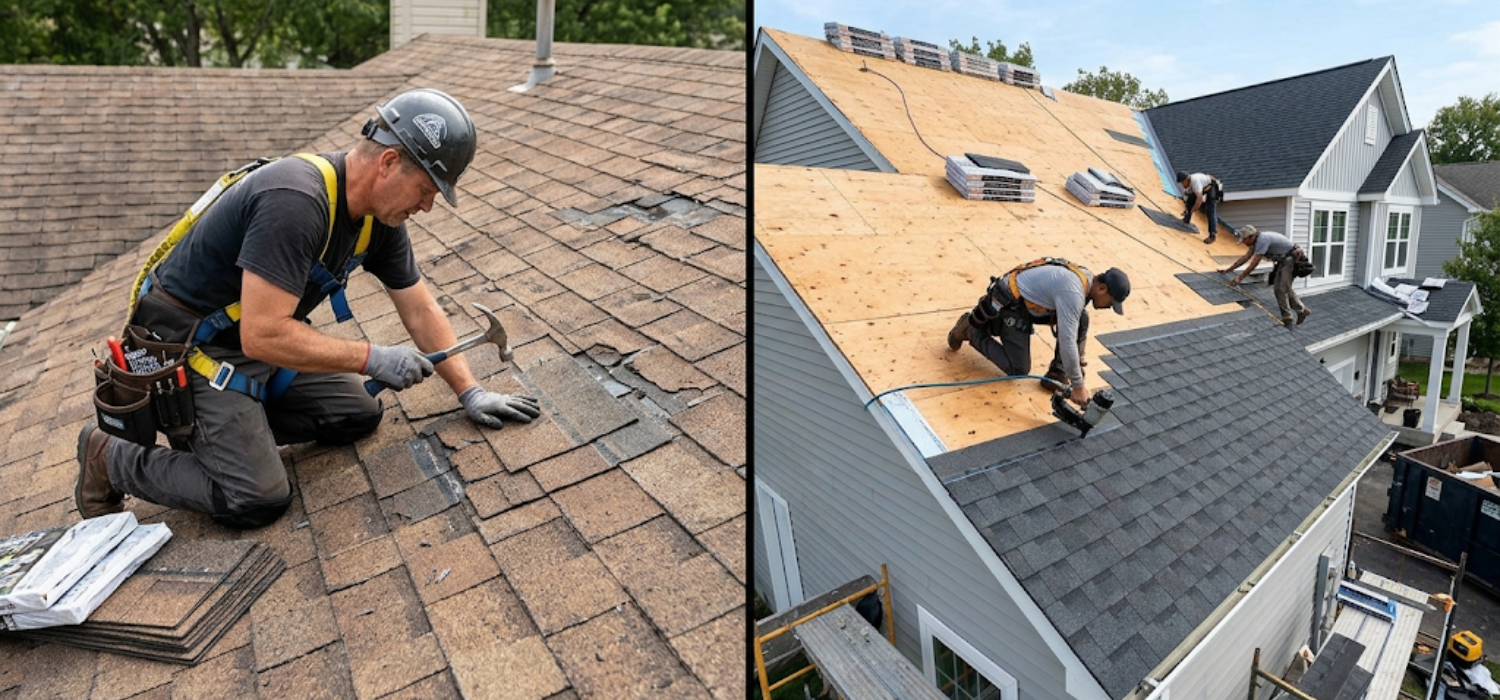
A full roof replacement involves removing all existing layers down to the wooden decking, inspecting and repairing structural wood, installing fresh underlayment and flashing, and laying down brand-new roofing materials.
Roof Replacement Directory
| Category | Details |
|---|---|
| Best For | Roofs over 20 years old |
| Widespread damage across multiple slopes | |
| Structural deck rot or sagging lines | |
| Average Cost | $8,000–$22,000 |
| Varies by square footage and materials | |
| Pros | Complete peace of mind (20–50 year warranty) |
| Higher home market value and curb appeal | |
| Lower monthly heating and cooling bills | |
| Cons | Higher initial financial investment |
| Multi-day installation process |
When Does Replacement Make Sense?
- Advanced Age: Your roof is past the 20-year mark and showing widespread signs of deterioration like curling shingles and heavy granule loss.
- Widespread Storm Impact: Hail or heavy winds have compromised multiple slopes across the entire house.
- Multiple Old Layers: Building codes in most areas restrict homes from having more than two layers of shingles. If your home already has two layers, future repairs become difficult, and any new work requires a full tear-off down to the deck.
- Home Resale Preparation: You plan to put your home on the market within the next few years. A new roof offers up to an 80% Return on Investment (ROI) and acts as a major selling point for buyers.
Advantages of Replacing
- Comprehensive Protection: Everything from the underlayment to the ridge caps is brand new, removing hidden structural leaks or rotted wood.
- Strong Warranties: Modern roofing systems come with robust manufacturer warranties covering materials for 20 to 50 years, paired with contractor workmanship guarantees.
- Energy Efficiency: New materials and proper attic ventilation reduce heat transfer, keeping your home cooler in the summer and warmer in the winter, which lowers your monthly utility bills.
- Instant Curb Appeal: A clean, modern roof instantly improves the look of your house and boosts your property value.
Cost Comparison: Breaking Down the Numbers
To help you visualize how costs accumulate, let's compare repair vs. replacement expenses over time.
The Immediate Upfront Difference
- Minor Repair: Typical costs range between $350 and $900. This covers replacing a few shingle bundles, patching flashing around a vent, or sealing a localized leak.
- Major Repair: Costs range between $1,000 and $2,500. This covers replacing large sections of shingles damaged by a fallen branch, fixing extensive valley flashing, or repairing underlying deck wood over a single room.
- Full Replacement: The average cost for a standard mid-sized single-family home ranges from $8,000 to $16,000 for architectural asphalt shingles. High-end materials like standing-seam metal, synthetic slate, or clay tile can range from $18,000 to $35,000+.
Understanding "Cost Over Time"
Consider this real-world scenario:
Scenario A: Your roof is 21 years old. A repair contractor fixes a leak over your garage for $700. Next spring, a heavy storm causes a leak over your master bedroom—another $850 repair. Next winter, ice dams lift shingles on your front porch—another $1,100 repair.
Result: You have spent $2,650 over two years on an old roof that still needs replacement, and you still face the risk of sudden water damage inside your home.
Scenario B: You recognize the 21-year-old roof has reached the end of its lifespan. You hire a licensed contractor for a full replacement costing $10,500.
Result: Your home is secure for the next 25+ years, your energy bills drop immediately, your home value rises, and you stop wasting money on temporary patches.
How to Choose the Right Local Roofing Contractor
Whether you need a minor repair or a complete replacement, the quality of your finished roof depends directly on the skill of the contractor you hire. The best materials in the world will fail early if installed improperly.
Here are 5 key criteria to evaluate before signing a contract:
1. Verify Local Licensing and Insurance
Never hire a contractor who cannot provide proof of current licensing and general liability insurance along with worker's compensation. If an uninsured worker falls off your roof, you as the homeowner could be held financially responsible for their medical bills.
2. Look for Manufacturer Certifications
Top roofing manufacturers (such as GAF, CertainTeed, and Owens Corning) offer specialized certifications to elite installers. Contractors with these credentials undergo regular training and can offer extended manufacturer warranties that non-certified installers cannot provide.
3. Require a Written, Itemized Estimate
A professional contractor will never give you a simple verbal "ballpark figure." Demand a clear, written estimate that details:
- The scope of work (tear-off vs. overlay, repair area square footage).
- Specific material brand names and product lines.
- Cleanup and debris disposal fees (dumpster rental).
- Project start and estimated completion dates.
- Payment terms and warranty specifics.
4. Check Local References and Reviews
Avoid out-of-state "storm chasers" who knock on your door after a major storm. Choose established, local roofing businesses with verifiable local addresses, strong community track records, and solid online customer ratings.
5. Compare at Least 3 Quotes
Never sign with the very first contractor who inspects your roof. Gathering 3 written quotes gives you a clear sense of fair market pricing in your zip code and helps you spot outliers—such as a price that seems suspiciously cheap or unnaturally inflated.
Simple Checklist: Repair vs. Replacement Decision Matrix
If you are still on the fence, run your situation through this quick evaluation checklist:
- What is the age of your roof?
- Under 12 years old: Strongly points toward Repair.
- 12 to 18 years old: Could go either way depending on overall condition.
- Over 20 years old: Strongly points toward Replacement.
- How widespread is the damage?
- Isolated to one small area: Repair.
- Scattered across multiple slopes: Replacement.
- Are you experiencing active internal leaks in multiple rooms?
- No / Only one spot near a chimney: Repair.
- Yes / Water staining in several areas: Replacement.
- Is your roof deck sagging or soft to the touch?
- No: Repair or Replacement.
- Yes: Replacement (Requires structural deck repair).
- How long do you plan to live in this home?
- Moving within 1 to 2 years: Repair (unless replacement is necessary to pass home inspection).
- Staying for 5+ years: Replacement (maximize your long-term comfort and investment value).
Get Expert Local Advice Today
Trying to assess your roof's condition from the ground with a pair of binoculars is stressful and inaccurate. Climbing up on a tall ladder yourself is dangerous.
The safest, smartest step you can take right now is to have an experienced, vetted roofing contractor climb up, inspect your shingles, check your attic ventilation, and give you an honest professional assessment.
When you use a local contractor network, you don't have to spend hours calling companies, leaving voicemails, or worrying about whether an installer is properly insured. You get matched directly with top-rated, licensed local professionals who understand the specific weather challenges in your area.
Ready to Find Out Where Your Roof Stands?
Don't wait for the next heavy rainstorm to turn a minor issue into an expensive indoor emergency. Take two minutes right now to request your free, zero-obligation estimates from checked local pros.
Compare side-by-side pricing, review options, and get the peace of mind that comes with knowing your home is fully protected from the elements.